

Legal help is available in your area. If you qualify, you may be eligible for free legal help. To find free legal help in Pennsylvania, visit https://clsphila.org/my-clean-slate/clean-slate-legal-help/
Finding Legal Help
General - Criminal Records
Pennsylvania records can be cleared through pardons, sealing, expungement, or vacatur.
- Pardon: While almost anyone with a criminal record can apply, some records can only be cleared by pardon. A pardon is a long process that can take 6 or more years, and the final decision is made by the governor. If a pardon is granted, the record will be expunged.
- Seal: Sealing hides a record so that it does not show up on background checks for jobs, school or housing. Sealing also provides important protections against discrimination. Most misdemeanor and many felony convictions can be sealed. Often, sealing requires that a petition is filed in court.
- Expunge: Expungement means that a record is erased and destroyed. Non-convictions (“Not Guilty” and dropped charges) can be expunged. A few very minor convictions are also eligible. Most of the time, an expungement requires that a petition is filed in court.
- Vacatur: Victims of human trafficking are eligible to have some convictions, such as prostitution, vacated (undone) and expunged (erased). Vacatur requires that a petition is filed in court.
Expungement completely erases and destroys a record. Sealing (limited access) hides the record so that it does not show up on background checks for employment, housing and education. Sealing also gives protections so the records cannot be used by schools, landlords or employers.
You can get a copy of your record today for free using our Clean Slate Screener tool.
You can also find your record here. Search by “Participant Name.” Enter a “Date Filed State Date” and “Date Filed End Date.” You can use 01/01/1900 as the start date, and today’s date as the end date. Enter the first and last name that is on your record, and your date of birth. Click “Search.” Click on the courthouse icon to see your record.
Expungement
Expungement is when a criminal record is completely erased. When a record is expunged, no one—not even the police or courts—has access to it. After a record has been expunged, it no longer exists. Not many kinds of records can be expunged.
Non-convictions, which are charges that did not result in a conviction, can be expunged. This includes charges that were “Dismissed”, “Withdrawn”, “Not Guilty”, and “Nolle Prossed”.
A small number of convictions (“Guilty” or “Nolo contendere”) can be expunged:
- Any Summary (“S”) convictions can be expunged if you have been arrest-free for five years following the conviction and paid all fines and costs.
- If you completed a diversionary program such as ARD, the Small Amount of Marijuana Program, or Section 17, your charges can be expunged.
- If you are at least 70-years old and have been arrest-free for 10 years, your convictions can be expunged.
- Many juvenile records can be expunged.
In rare situations, an expungement can happen automatically. Automatic expungements happen after a case is pardoned, or if a person is found “Not Guilty” on every charge against them.
In all other cases, expungement requires a petition to be filed in court. We recommend that you find legal help to file a petition.
You may be able to file petitions on your own using these forms for expungement. Please note that there are filing fees for each petition you file. Before you file, you should call the court clerk’s office in the county where the arrest took place to find out what documentation you will need.
Sealing - Limited Access (Clean Slate)
Sealing hides your record, so it does not show up on background checks for employment, housing and education. Employers, landlords and schools cannot use sealed records against you.
Sealing will help you access jobs, housing and education because your sealed records will not appear on background checks. You do not have to tell employers, landlords or schools about a sealed record, and in these situations, the record cannot be used against you. If you are denied a job or fired because of a sealed record, you should get legal help.
There are some exceptions to this rule. If a federal law requires an employer to consider your criminal record, that employer can access sealed records. This applies to a small number of employers.
The Department of Human Services and criminal justice agencies, including law enforcement and criminal courts, have access to sealed records.
School, landlords and most employers do not have access to sealed records.
Most felony and misdemeanor offenses in these categories can be sealed:
- Drug crimes
- Theft crimes, including Retail Theft and Receiving Stolen Property
- Trespass
- Forgery & Fraud crimes, incl. Access/Devise Fraud, Bad Checks, ID Theft and Welfare Fraud
- Criminal Mischief
Most other misdemeanors can be sealed, including:
- DUI
- Simple Assault
- Disorderly Conduct
- Harassment
- Terroristic threats
- Recklessly Endangering Another Person
- Resisting Arrest
- Possession of an Instrument of a Crime
- Prostitution
All summary convictions and nonconvictions (“Not Guilty” and dropped charges) can be sealed.
Eligibility rules are complicated. Use the Clean Slate Screener to find out how to clear your record.
- Summary convictions will be sealed after 5 years.
- Eligible misdemeanor convictions can usually be sealed after 7 years without another misdemeanor or felony conviction.
- Eligible felony convictions can usually be sealed after 10 years without another misdemeanor or felony conviction.
- Nonconvictions (“Not Guilty” and dropped charges) are sealed after 30 days.
Eligibility rules are complicated. Use the Clean Slate Screener to find out how to clear your record.
You do not need to pay court costs, fees or fines to seal your record.
However, if restitution was ordered, the restitution must be paid before your record can be sealed. Restitution is money owed to a victim. Learn more about court debt in the “Court Debt” section of this FAQ.
There are two ways records are sealed in Pennsylvania: by automatic sealing or by petition sealing. Automatic sealing means the record will be sealed without you needing to do anything. Petition sealing means that a petition must be filed in court.
Non-convictions (“Not Guilty” and dropped charges) and summary convictions are always automatically sealed. Some misdemeanor and felony convictions are sealed automatically, and some require that a petition be filed in court.
Eligibility rules are complicated. Use the Clean Slate Screener to find out how to clear your record.
Your nonconvictions (“Not Guilty” and dropped charges) and summary convictions will be automatically sealed. Your misdemeanor and felony convictions may be sealed automatically, but some require that a petition be filed in court.
Eligibility rules are complicated. Use the Clean Slate Screener to find out how to clear your record.
You still have access to your own full criminal record, so you can see what cases were sealed.
First, look up your record using the Clean Slate Screener. A sealed record will not show up when you search, because it is hidden from the public. If your record does not appear, that could mean that your record is sealed.
If you think that your case has been sealed but want to be sure, you can visit the clerk of courts in any Pennsylvania courthouse and ask for a copy of your complete record, including sealed cases. Bring your ID so you can prove who you are.
You can also get an “Access and Review” record by mail from the Pennsylvania State Police. You can download the form here and mail it to the address listed on the form. You will need to send a money order or check for $20, payable to “Commonwealth of Pennsylvania”, as well as a copy of any government issued photo ID.
Pardons
A pardon is an act of clemency, or “forgiveness”, that fully restores an individual’s rights and makes them as innocent as they were before they were convicted. The Board of Pardons makes recommendations for who should get a pardon. Those recommended must then be approved by the Governor of Pennsylvania. Pardoned convictions are automatically expunged every 3 months.
A pardon is the only way some convictions, such as violent, sexual or gun-related first-degree misdemeanors and felonies, can be cleared from criminal records.
A pardon is a much longer process than sealing or expungement, and the chance of getting a pardon is smaller. The entire process can take 6 years or more. However, the Board of Pardons has recently changed the pardon process to make it easier to apply.
According to the Board of Pardons, some factors that influence their decisions include:
- How much time has passed since your conviction?
- Have you complied with all court requirements and paid off costs, fines, and restitution?
- Are you remorseful?
- Have you attended the required treatment sessions and/or classes?
- Have you made positive changes to your life (career, education, community involvement, etc.) since your conviction?
- Why do you need a pardon? How does having a criminal record affect your daily life?
- Was there a victim, and if so, how did your crime impact the victim?
You can start working on your application soon after your conviction, but you are more likely to be successful if you wait before sending it in. Most people who receive pardons have waited 5 to 10 years after finishing their sentence before applying.
A person with a less serious record (misdemeanor convictions or nonviolent felony convictions) may be successful after a shorter period, such as 5 years. Someone with a serious felony record should consider waiting a longer period, such as 10 years, before applying for a pardon.
If you want to apply for a pardon in the future, you should keep track of any successes, good deeds, and efforts you’ve made to improve yourself since the crime.
It is never too late to ask for a pardon – if you have old convictions following you around, you may be a good candidate for a pardon.
1) Complete the application
Download the pardon application here.
2) Get your court records
Request copies of the required court records to include with your application. These can be obtained from the court clerk in the county where you were convicted. Read here for more information about which records are required.
3) Gather supporting documents
Start collecting supporting documents that show your character, education and other accomplishments. These could include letters of recommendation from your friends, family, coworkers or community members, or certificates and diplomas that show your education or work accomplishments.
4) Write your essays
Write essays explaining your convictions. Make sure to provide thoughtful, detailed answers on the application and, if possible, show that you take responsibility for the actions that led to your conviction. We recommend that you read the court records before writing these essays, to make sure you don’t leave out important information.
5) Draft your personal statement
The pardon application gives you an option to write a personal statement. Though it is optional, we recommend that everyone write a personal statement. In your personal statement, you can talk about the positive changes you have made to your life (career, education, community involvement, etc.) since your conviction. You can also explain why you need a pardon, and how your convictions have negatively impacted your life.
6) Submit your application
Submit your application, personal statement and supporting documents to the Board of Pardons, following the instructions on the application. If at any time your contact information changes, you must inform the Board of Pardons as soon as possible.
Fines and Costs
Even if you don’t know it, you may owe fines and costs on your convictions. The Board of Pardons thinks the payment of court fines and costs is extremely important. To make payments online, visit the UJS Portal.
If you were convicted in Philadelphia, you can also go to the basement of the Criminal Justice Center at 1301 Filbert St. to make payments. You can call (215)- 683-7999 or email occ@courts.phila.gov for help in setting up a payment plan. If you cannot pay your fees, talk to your legal representative to see if your fees can be removed.
After you apply, there are several steps in the review process before a pardon is granted.
1) Your Application will Be Filed
Around 18 months after submitting your pardon application, the Board of Pardons will review your application to make sure it is complete and will officially “file” it. The Board may be in touch with you about any errors on your application, so check your email regularly and keep the Board of Pardons updated if your contact information has changed. Email bopclemency@pa.gov with updates to your contact information or application.
2) Interview
Next, you will be interviewed by a parole agent from the Department of Corrections. They may ask you about your application, updates to your situation, and about your work history and finances. A representative from the District Attorney’s Office may also contact you to interview you. These interviews will become part of your application package that goes to the Board to review.
3) Merit Review
A few years after your application is filed, and once your parole agent interview is complete, you will be scheduled for a merit review. The Board will review your application and materials and vote on whether to grant you a hearing. Two out of the five members of the Board must vote in your favor for you to get a hearing.
4) Hearing
If you are granted a hearing, it will be over the computer program Zoom. You will be able to watch the live broadcast, and will be in a virtual waiting room until it is your turn. The Board may ask you to briefly present why you are a good pardon candidate and answer questions about your application. They may ask you about any drug or alcohol use or mental health treatment, among other things. The Board will vote on your application the same day. Three out of the five Board members must vote in your favor for you to be recommended.
5) Governor Review
The Governor will review the recommendations made by the Board of Pardons and decide whether to grant or deny the pardon. There is no deadline for the Governor to act and it regularly takes six months to one year, or longer.
6) Expungement
If you are granted a pardon, your rights are fully restored. Your record should be automatically expunged without you needing to do anything. If it has been several months since receiving your pardon and your record has not yet been expunged, you may want to contact the Board of Pardons or get legal help to file an expungement petition.
Court Debt: Fines, Fees and Restitution
Only some types of record clearing require that all court debts (fees, costs, fines and restitution) be paid. Court debt must be paid to expunge or pardon a record. A record can be sealed if court debt is still owed, but a record will not be sealed if restitution (money owed to a victim) is due.
Our Clean Slate Screener will tell you if you owe restitution.
To find out if you owe other fees and to look at the amount you owe, look up your record in the UJS Portal. If you know your docket number(s), you can search by “Docket Number.” If not, search by “Participant Name.” Enter a “Date Filed State Date” and “Date Filed End Date.” You can use 01/01/1900 as the start date, and today’s date as the end date. Enter the first and last name that is on your record, and your date of birth. Click “Search.”
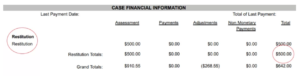
Your fee information is on your docket sheets. Click on the “D” icon for each of your cases to view your docket sheets. The last page of the docket sheet shows what money was charged and how much has been paid. The total amount you currently owe is under the far-right column (“Total”).
If restitution was imposed, your court fees page will have a “Restitution” category. The “Total” column on the right side will show if you owe restitution.
Fines, fees (including probation fees) and costs may be able to be removed if you are unable to pay. Restitution can be removed under some limited circumstances. If you owe money to the court and you cannot afford to pay the total amount, you can seek legal help or visit the motions desk of the court where you were convicted to file a motion on your own.
To make payments online, visit the UJS Portal.
To find out if you owe fees and ask about payment plan options, contact the court where you were convicted. If you were convicted in Philadelphia, you can go to the basement of the Criminal Justice Center at 1301 Filbert St. to make payments.
If you were conviction in Philadelphia and need to get into an affordable payment plan, you can do so by:
- OPTION 1: Complete the Financial Information Form. Once completed, click the submit button and a representative of the Office of Court Compliance will contact you.
- OPTION 2: Call 215-683-7999 between the hours of 8:00 AM and 5:00 AM, Monday through Friday or email occ@courts.phila.gov for assistance in setting up a payment plan.